
To cut interest rates, the central bank head has to open up a debate on inflation target revision.

DBS called Rajan's decision not to seek an extension as a 'negative surprise'.

The rupee tumbled 3 per cent against the US dollar in 2024 as concerns over slower economic growth and a stronger greenback in global markets weighed, but it was among the least volatile currencies in the world and the headwinds may be less intense in the coming year.

Even as the high inflation figure for October has ruled out any possibility of a rate cut by the Reserve Bank of India's (RBI's) monetary policy committee (MPC) in December, a rate cut in February also looks uncertain due to global uncertainties. Economists told Business Standard that unless domestic growth slows markedly, the outlook on rate cut remains unclear. India's headline inflation touched a 14-month high of 6.2 per cent in October, breaching the MPC's upper tolerance band of 6 per cent.

'The 'Off-with-Rajan's-head' brigade bases its arguments on mistaken beliefs, erroneous causalities, and even downright prejudice.'

A selection committee, headed by Reserve Bank of India (RBI) Governor D Subbarao, is scheduled to meet next week to shortlist candidates for the post of the deputy governor of the central bank.
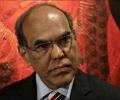
In his new role, Subbarao will take part in various activities at NUS Business School, the Institute of South Asian Studies and the Monetary Authority of Singapore.

The friction with the political class is not only about interest rates and monetary policy. While the government often spoke freely about its discomfiture, the RBI had to be careful even in its response to the government as any loose statement would affect the markets.

Raghuram Rajan called for purposeful and effective action to counter the atmosphere of cynicism, which has slowed down the decision making process.
The Reserve Bank of India is closely monitoring liquidity to decide whether it needs to take fresh measures to absorb excess funds from the banking system, the central bank's deputy governor said on Saturday.

After opting for status quo in policy rates, Reserve Bank Governor Raghuram Rajan on Tuesday said any more cut will depend on further transmission of previous rate cuts by banks, softening in inflation and progress of monsoon.

The Reserve Bank of India on Friday decided to keep the policy rate unchanged at 6.5 per cent for the fifth time in a row as it maintains a tight vigil on inflation. The rate increase cycle was paused in April after six consecutive rate hikes, aggregating to 250 basis points since May 2022. Announcing the bi-monthly monetary policy, RBI Governor Shaktikanta Das said the Monetary Policy Committee (MPC) unanimously decided to keep the repo rate unchanged at 6.5 per cent.
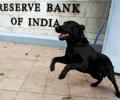
The central bank has nine executive directors, and one of them -- S Karuppasamy -- retired recently. R Gandhi, who was executive director, has now been promoted to the post of deputy governor.

The Reserve Bank of India on Friday slashed the growth projection to 7 per cent for the current fiscal from the earlier forecast of 7.2 per cent, citing aggressive tightening of monetary policies globally and moderation in demand. Unveiling the fifth monetary policy for this fiscal, RBI Governor Shaktikanta Das said the central bank remains committed to price stability to put the country on the sustained path of growth.

He will be the eighth Deputy Governor to be made Governor at RBI
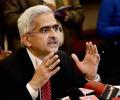
Reserve Bank Governor Shaktikanta Das on Monday said despite the latest headwinds arising from the Jackson Hole summit leading to extreme volatility, our banking system and financial markets are strong enough to withstand such pressures. Taking the markets by surprise, US Fed chair Jerome Powell had told the annual Jackson Hole summit of central bankers and economists last week that he would have to keep raising federal fund rates to tame inflation, which remains the biggest challenge to the world's largest economy. He also warned of the pains that such monetary policy actions would create on growth and jobs.

Seasoned bureaucrat and a stickler for rules Finance Secretary Tuhin Kanta Pandey will be at the helm of capital market regulator, Securities and Exchange Board of India (SEBI), for three years. The 1987-batch Odisha-cadre Indian Administrative Service (IAS) officer, Pandey, would replace Madhabi Puri Buch, whose three-year term ends on Friday.

Takao replaced Haruhiko Kuroda, who had, in March, quit ADB to take charge as Japan's central bank governor.

Already retail inflation has risen to 6.07 per cent in February, crossing the upper band of the Parliamentary mandate. This is the second consecutive month in 2022 when retail inflation has crossed the 6 per cent mark having hit 6.01 per cent in January.

The need to maintain people's confidence in digital banking resulted in the action against HDFC Bank for service outages, RBI Governor Shaktikanta Das said on Friday and exhorted lenders to invest more on the technology front.

Raghuram Rajan has appointed him as head of several committees soon after taking charge.

Soaring vegetable prices pushed the retail inflation rate to a nine-month high of 5.49 pr cent in September, according to government data released on Monday. The consumer price index (CPI)-based retail inflation rate was 3.65 per cent in August and 5.02 per in September 2023. The previous high inflation rate was witnessed in December 2023 at 5.69 per cent.

Days after the government said the Reserve Bank will introduce a digital currency in 2022-23, Governor Shaktikanta Das on Thursday said the central bank does not want to rush and is carefully examining all aspects before introduction of the Central Bank Digital Currency (CBDC). He, however, declined to give any timeline for the launch of the CBDC. In her Budget 2022-23 speech, Finance Minister Nirmala Sitharaman had announced that the RBI will introduce a digital currency in the next financial year beginning April 2022 to boost the digital economy and for more efficient currency management.

Reserve Bank of India Governor Urjit Patel is learnt to have told the parliamentary panel on demonetisation that discussions between the central bank and the government on the process began early last year.
The Reserve Bank of India will maintain a soft interest rate bias, the central bank's Governor said
Financial inclusion has two parameters- access and use of banking services.
Financial inclusion has two aspects- access and use of banking services.

The speed at which he led the central bank in different areas -- ranging from internal reorganisation to inflation fighting, stabilising the currency, taking on rogue corporations, cleaning up bank balance sheets, and opening the sector -- makes one believe that Rajan knew he had only three years to do his job. A fascinating excerpt from Tamal Bandyopadhyay's MUST-READ Roller Coaster: An Affair with Banking.
The government on Tuesday appointed three external members -- Ram Singh, Saugata Bhattacharya and Nagesh Kumar -- to the RBI's rate-setting Monetary Policy Committee for four years. The central government has reconstituted the Monetary Policy Committee (MPC) of RBI, the finance ministry said in a statement. Ram Singh is the director of the Delhi School of Economics, Saugata Bhattacharya is an economist, and Nagesh Kumar is the director and Chief Executive, Institute for Studies in Industrial Development, New Delhi.

Duvvuri Subbarao recounts how his tensions with P Chidambaram and Pranab Mukherjee, then finance ministers, over monetary policy spilled over into other issues in the central bank in this excerpt from Who Moved My Interest Rate?, his memoir of his term as Reserve Bank of India governor.

The average time lag between the date of occurrence of a fraud and its detection is 23 months; for large frauds (Rs 100 crore and above), it was 57 months.
Like other central banks, the Reserve Bank of India is also concerned that spurt in food, commodity and oil prices coupled with fears of US recession could fuel inflation and slow down the economic growth. RBI Governor Y V Reddy and Deputy Governor Rakesh Mohan are also expected to deliberate on the impact of recent policy measures announced by the central bank.

Probably 35 bps. There could be even an encore in February 2023 to take the policy rate to 6.5% before the financial year ends, predicts Tamal Bandyopadhyay.
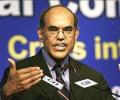
RBI had launched the investigation into the working of banks following the expose which showed some bankers giving suggestions to customers on ways to bypass regulatory norms.
While there are certainly more hawks perched on monetary policy committees of central banks around the world now than a couple of months ago, the doves still have the upper hand.
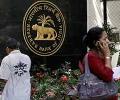
RBI governor Raghuram Rajan said, banks may be soon allowed to increase stake above the current cap of 10 per cent in companies undergoing debt restructuring.

Reserve Bank of India (RBI) deputy governor M Rajeshwar Rao on Wednesday defended the central bank's decision of not allowing industrial houses to float banks, and said more deliberations are needed before RBI changes its stance on this issue agreed back in 2001. An internal working group (IWG) of the RBI had recommended allowing industrial groups into banking, but late last month the RBI said it kept on hold the two recommendations of allowing industrial houses and large non-banks to float banks. However, RBI had accepted 21 of the 33 recommendations of the group that submitted its report a year ago.

The central bank dashed hopes of any steep interest rate reduction.
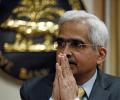
200 staffers, consisting of RBI officials and support teams, who are essential to perform critical functions, were isolated at a separate facility in a dedicated quarantined environment near all three RBI data centres.

If the policy is extended to NBFCs and co-operative banks, they will have to disclose divergence in asset classification and provisioning during RBI inspections in their audited financial reports. Till now, these entities have been exempted from this. At present, there are more than 98,000 co-operative banks and 10,000 NBFCs. Sources said the RBI would concentrate on the top 50 co-operative banks and NBFCs.
